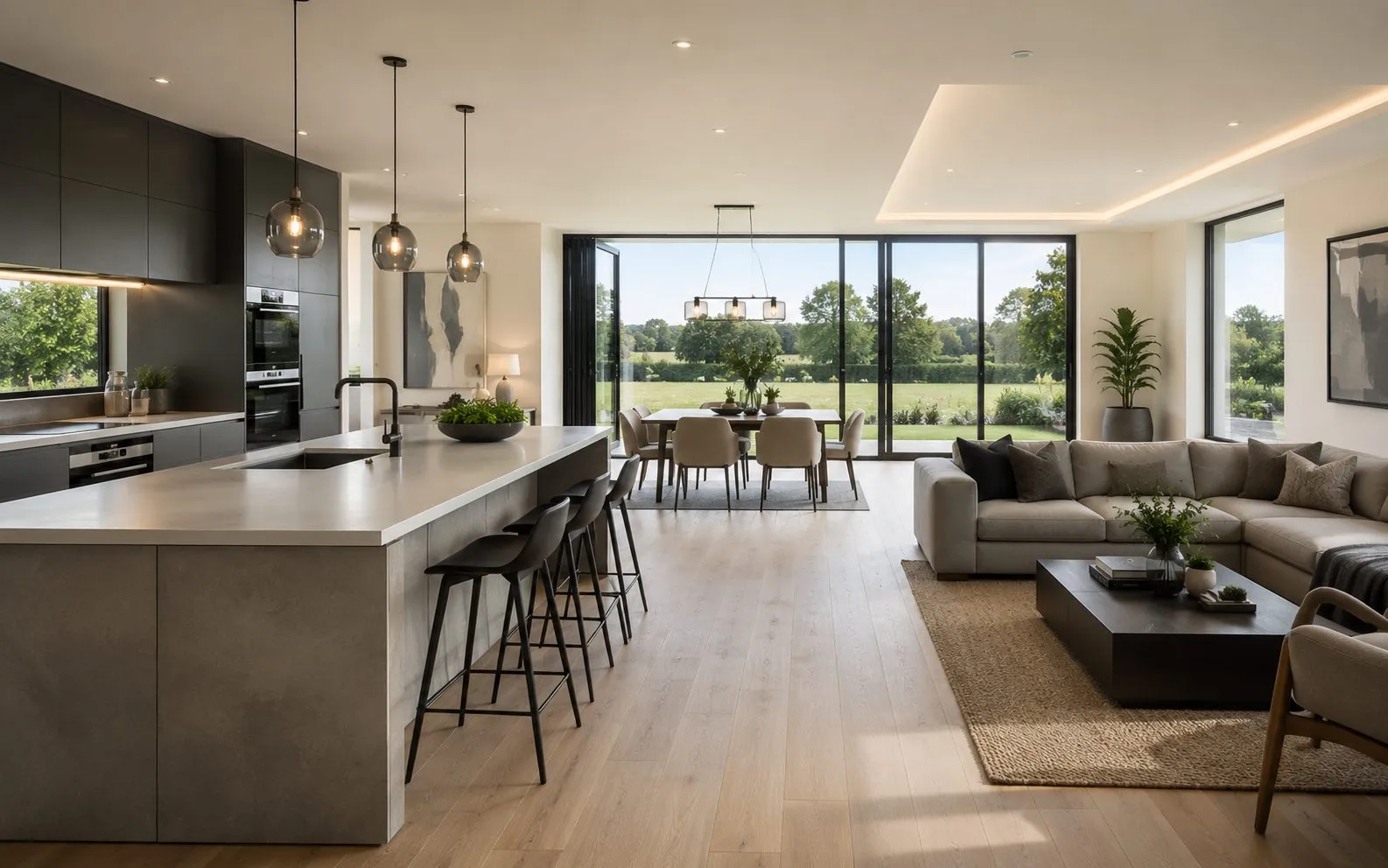
Prime residential construction in Battersea & Clapham
Crown Building works at the top of the London market, and Battersea & Clapham is core territory for our team. The projects in our published case studies were delivered under exactly the constraints that define this part of London. Protected fabric, exacting consents, discreet site conduct and clients who judge the result at touching distance.
Every project has a dedicated team behind it. Meticulous programming, a trusted specialist supply chain and senior management present on site throughout are the baseline for every commission we accept in Battersea & Clapham. The standard does not change with the scale of the project.
What we build in Battersea & Clapham
Our residential work spans the full scope of high end building. We deliver architecturally distinctive new build homes, private residence refurbishments and structural reconfigurations, single and multistorey extensions, basement excavations, listed and period property works, and the bespoke joinery and interiors that define a finished home. Each project is delivered as design and build or contractor only, with Crown appointed as your prime residential main contractor, and transparent, itemised pricing from the outset. Commercial occupiers are served by the same teams through our commercial fit out division, and clinical and wellness premises through our healthcare and specialist environments team.
Between the commons, along Northcote Road's ladder streets and around Clapham Old Town, the brief repeats with conviction: open the ground floor with a side return or wrap extension, excavate a lower ground floor for utility and play space, convert the loft, and refinish the house to a standard the street's values now justify. Wandsworth and Lambeth planning are pragmatic but particular, party walls are everywhere, and the houses are tightly packed. Preconstruction logistics decide how smoothly a programme runs. This is Chelsea grade execution applied to family house London, ten minutes south of our published Chelsea project.
Areas we serve
We work across Battersea and Clapham, between the commons, the Northcote Road ladders, Clapham Old Town, Abbeville Village and the Nightingale Triangle. Plus Balham, Wandsworth Common and Putney. You can see our full coverage, London within the M25 and a fifteen mile radius of our Watford headquarters, on our areas we cover page.
One address, two boroughs, two different basement rules
Battersea and Clapham straddle the Wandsworth and Lambeth boundary, and the two councils treat basements quite differently. Establishing which authority you are in is the first question on any below ground scheme here, because the answer materially changes what is achievable.
In Wandsworth, Policy LP6 permits one storey only and limits a residential basement to no more than fifty per cent of the existing rear garden or other undeveloped garden area, excluding the original footprint. At least one metre of naturally draining permeable soil is required above any garden basement, together with a minimum two hundred millimetre drainage layer, and a positive pumped device is required against sewer flooding. Lightwells in conservation areas must retain at least two metres or fifty per cent of the original front garden depth, whichever is greater. The Council's guidance states plainly that multi level basements are not appropriate in Wandsworth.
In Lambeth, Policy Q27 is tighter again. A rear basement extension must retain no less than seventy per cent of the rear garden free of subterranean development at original ground level, against Wandsworth's fifty. Only one storey is permitted and no basement is allowed beneath an existing basement or semi basement. Every application requires a Stage 1 screening Basement Impact Assessment, with further stages independently assessed at the applicant's cost, and the author must be a Chartered Engineer or equivalent, with a CARE accredited engineer required where the building is listed.
Neither borough has a basement Article 4, and what that means
Unlike Kensington and Chelsea, Westminster, Camden, Hammersmith and Fulham or Richmond, neither Wandsworth nor Lambeth has made a borough wide Article 4 Direction removing permitted development rights for basements. In principle that leaves more scope, but it is a narrower advantage than it sounds and worth understanding rather than relying on.
Permitted development for below ground work is limited in any event, most of these properties sit in conservation areas where rights are already curtailed, and both boroughs impose demanding assessment requirements on anything requiring an application. Wandsworth has forty six conservation areas and Lambeth sixty two covering around thirty per cent of that borough, and Article 4 directions cover a number of Wandsworth estates including the Heaver, Latchmere and Shaftesbury Park Estates. The realistic position is that most schemes of any ambition need permission, and the useful work is establishing the constraints early rather than hoping to avoid the process.
Flood risk, the Thames defences and Metropolitan Open Land
Wandsworth's Local Plan sets specific requirements for basements by flood zone, refusing highly vulnerable uses such as self contained basement flats and basement bedrooms in higher risk zones, and adding requirements in areas of defended tidal flood risk sitting behind the Thames Tidal Defence system. A good deal of Battersea falls into that category, and the defended status is a planning consideration rather than a reassurance.
On the Lambeth side, Clapham Common is designated Metropolitan Open Land, which carries protection equivalent to Green Belt under the London Plan. Development affecting it, or its setting, is assessed on that basis. The stock around it is largely eighteenth and nineteenth century, with extensive mid to late nineteenth century residential development beyond the Common's edges, and around Clapham Junction the Council describes tightly knit terraces of narrow fronted properties generally three to four storeys high.
Speak to us about your Battersea & Clapham project
If you are planning a refurbishment, basement or new build in Battersea & Clapham, call us on 020 3675 3999 or book a free consultation here.
Frequently asked questions
Where is Crown Building based?
Crown Building is a prime residential contractor working throughout London. Its London projects include a £7m five level private residence on The Bishops Avenue, Hampstead, a £1.9m apartment in Mayfair and a £1.1m residence in Chelsea. The head office is at Unit 324-B, The Wenta Business Centre, Colne Way, Watford, WD24 7ND, and we also work across Hertfordshire and the Home Counties.
Which areas around Battersea & Clapham do you cover?
We cover between the commons, the Northcote Road ladders, Clapham Old Town, Abbeville Village and the Nightingale Triangle, plus Balham and Wandsworth.
Do you deliver full house transformations between the commons?
Yes, extension, basement, loft and complete refurbishment as one contract with one programme and one point of accountability. Our Chelsea case study shows the finish standard we bring south of the river.
Planning a project in Battersea & Clapham?
Crown Building offers a free initial consultation: no cost, no commitment. Speak to our senior team about your project today.
Book a Free Consultation