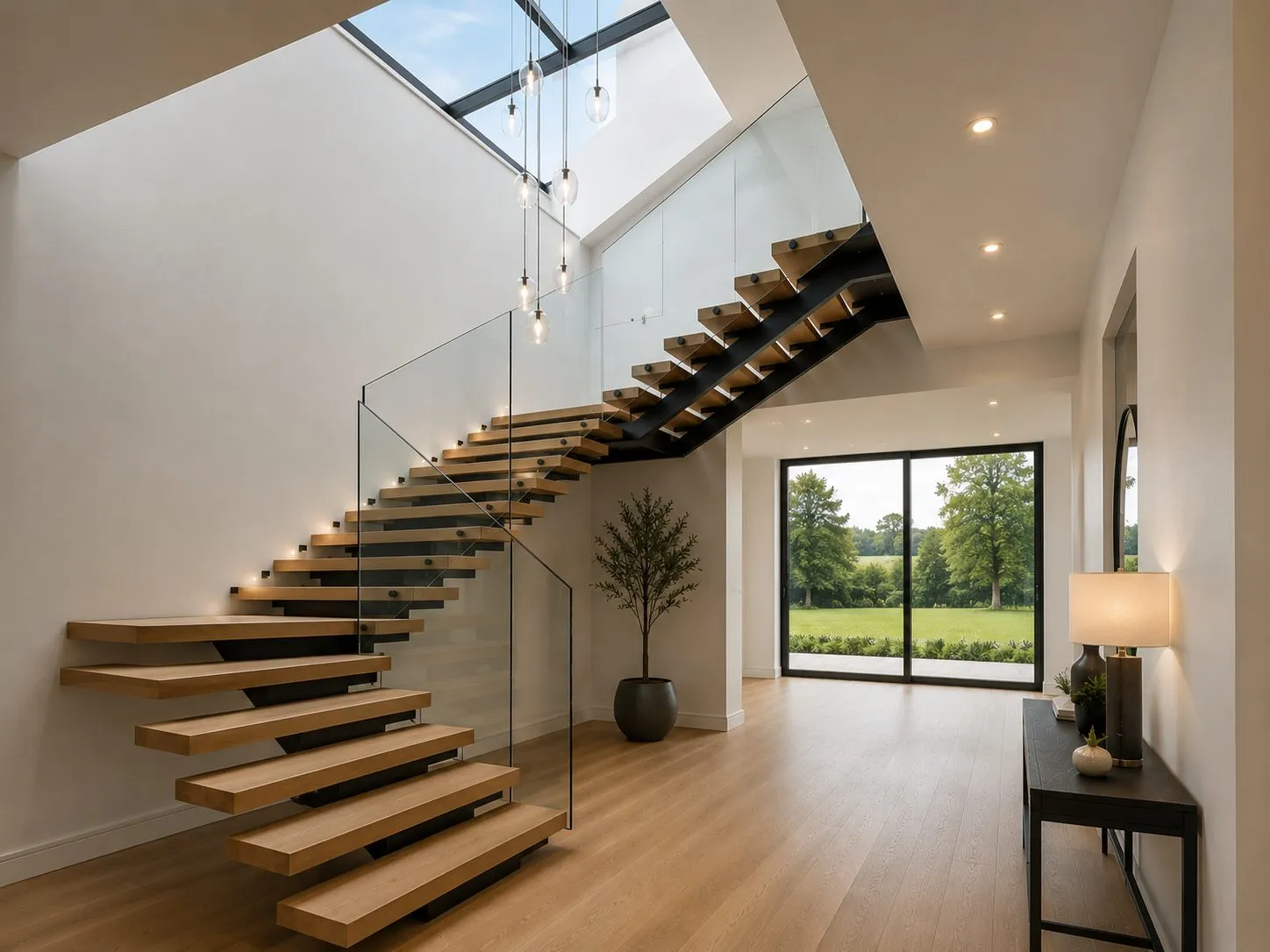
Protected fabric, modern comfort
Our heritage workload spans Georgian terraces in Islington and Blackheath, listed villas in Hampstead and Highgate, and conservation area houses from St Albans to Sevenoaks. The discipline is constant: understand the fabric before touching it, document everything, and use trades who work lime, timber and stone the way the original builders did.
We do not operate at volume. We compete on execution. Meticulous programming, a trusted specialist supply chain and senior management present on site throughout are the baseline for every commission we accept in London. The standard does not change with the scale of the project.
Heritage craft, modern comfort
We manage Listed Building Consent applications and conditions, structural interventions engineered around protected fabric, traditional lime plasters and mortars, sash window and joinery restoration, and the quiet integration of modern services, insulation and bespoke joinery, with conservation officers treated as collaborators rather than obstacles.
The test of listed work is the join between old and new: an underfloor heating manifold that never announces itself, a bathroom carved into a Georgian plan without a scar, cornicing run in situ to match a profile cast two centuries ago. It demands a different pace and a documented methodology, and it is precisely the work our supply chain was assembled for. Our listed building guide explains consents, realistic costs and where the genuine risks sit.
Areas we serve
Heritage projects run across our whole coverage, Islington, Greenwich and Blackheath, Hampstead, Highgate, Richmond, St Albans' conservation core and the listed villages of Hertfordshire and Surrey. You can see our full coverage, London within the M25 and a fifteen mile radius of our Watford headquarters, on our areas we cover page.
Unauthorised work to a listed building is a criminal offence
This is the point that separates listed work from everything else a contractor does. Under section 9 of the Planning (Listed Buildings and Conservation Areas) Act 1990, carrying out works that affect the character of a listed building without consent is a criminal offence. It is not a planning breach to be regularised later. There is no time limit on enforcement, unlike ordinary planning breaches, and liability can attach to the contractor as well as the owner. Ignorance that the building was listed is not a defence.
The practical consequence is that the consent position has to be established before anyone lifts a tool, and it has to be established for the whole building rather than the part being worked on. Listing covers the entire structure, inside and out, including later additions. It also extends to objects and structures fixed to the building, and to free standing structures within the curtilage that pre-date 1 July 1948. A garden wall, an outbuilding or a set of railings can be listed by virtue of the house they sit beside without appearing anywhere in the list description.
The list description itself is the most misread document in the process. It exists to aid identification, not to define what is protected. Historic England states this explicitly. A description that mentions only the façade does not mean the interior is unprotected, and the absence of a feature from the text says nothing about its significance. On post war listings such as the Barbican the descriptions run to considerable interior detail; on a Georgian terrace listed in the 1950s there may be two sentences covering a building where the staircase, joinery and plan form are the whole point.
Consent, and the three things that actually get refused
Listed building consent is decided by the local authority, is free of application fee, and normally takes eight weeks, though complex cases run to thirteen. Where a building is Grade I or Grade II star, or where the work involves demolition, the application must be notified to Historic England and in some cases to the national amenity societies. That notification stage is what turns an eight week programme into four months, and it is foreseeable rather than bad luck.
Refusals cluster around three things. The first is plan form: removing walls to open up a plan is the single most commonly refused item, because the arrangement of rooms is usually the clearest surviving evidence of how a building was used. The second is joinery and glazing: replacement windows, altered fenestration patterns and secondary or double glazing are routinely resisted on principal elevations, and replacement of historic glass is treated as loss of fabric rather than maintenance. The third is services: comfort cooling, extract, underfloor heating and the associated routing require chasing, penetrations and floor lift, which is where most of the harm to fabric actually occurs.
The framework the decision is made under is harm against public benefit. Where harm is judged substantial, consent is refused unless the case is exceptional. Where it is less than substantial, it is weighed against the benefits of the proposal. That is a genuinely arguable test, and it is argued on evidence. A well prepared Heritage Statement that identifies significance element by element and explains how the design responds to it will carry a scheme that a drawing set alone will not.
Working practice, and the parts of the job that carry the risk
On site the discipline is different from new work in ways that show up in the programme rather than the specification. Opening up is not a formality: what is behind a plaster face on a building of this age is unknown, and the sensible approach is a programme of investigation at feasibility with provisional sums carried against what it finds, rather than a fixed price against an assumption. Lime plaster, lath, historic brick in lime mortar and softwood structure all behave differently from their modern equivalents, and the common failure mode is not collapse but moisture, where a cement render or an impermeable paint traps water in a wall that was designed to breathe. Where the works reach below ground, that same principle governs the waterproofing design: a system specified without regard for vapour permeability will move the problem rather than solve it.
The other risk sits in sequencing. Consent conditions frequently require sample panels, method statements or recording to be approved before work starts on a given element, and those approvals are separate from the consent itself. A contractor who treats them as paperwork will find a hold on the critical path at exactly the point the trades are mobilised. We price the discharge of conditions as a distinct activity with its own duration.
Where a building is also in a conservation area or subject to a leasehold licence to alter, the consents stack rather than replace one another. Listed building consent, planning permission, building regulations approval and a landlord's licence are four separate processes with four separate timescales, and none of them entitles you to start until the others are in place. Establishing that sequence at the outset is the most valuable half day on the whole project.
Discuss your listed property
If you are planning a refurbishment, basement or new build in London, call us on 020 3675 3999 or book a free consultation here. Every enquiry is handled by a director.
Frequently asked questions
Where is Crown Building based?
Crown Building's registered office is at Unit 324-B, The Wenta Business Centre, Colne Way, Watford, WD24 7ND. We work throughout London within the M25 and across Hertfordshire and the Home Counties.
Which areas around London do you cover?
Across the full coverage area, with current heritage concentrations in Islington, Blackheath, Hampstead, Richmond and St Albans.
Do you handle Listed Building Consent applications?
Yes, we prepare and manage LBC applications and discharge conditions as part of preconstruction, alongside Historic England methodology, heritage method statements and party wall procedures.
Planning a project in London?
Crown Building offers a free initial consultation: no cost, no commitment. Speak to our senior team about your project today.
Book a Free Consultation