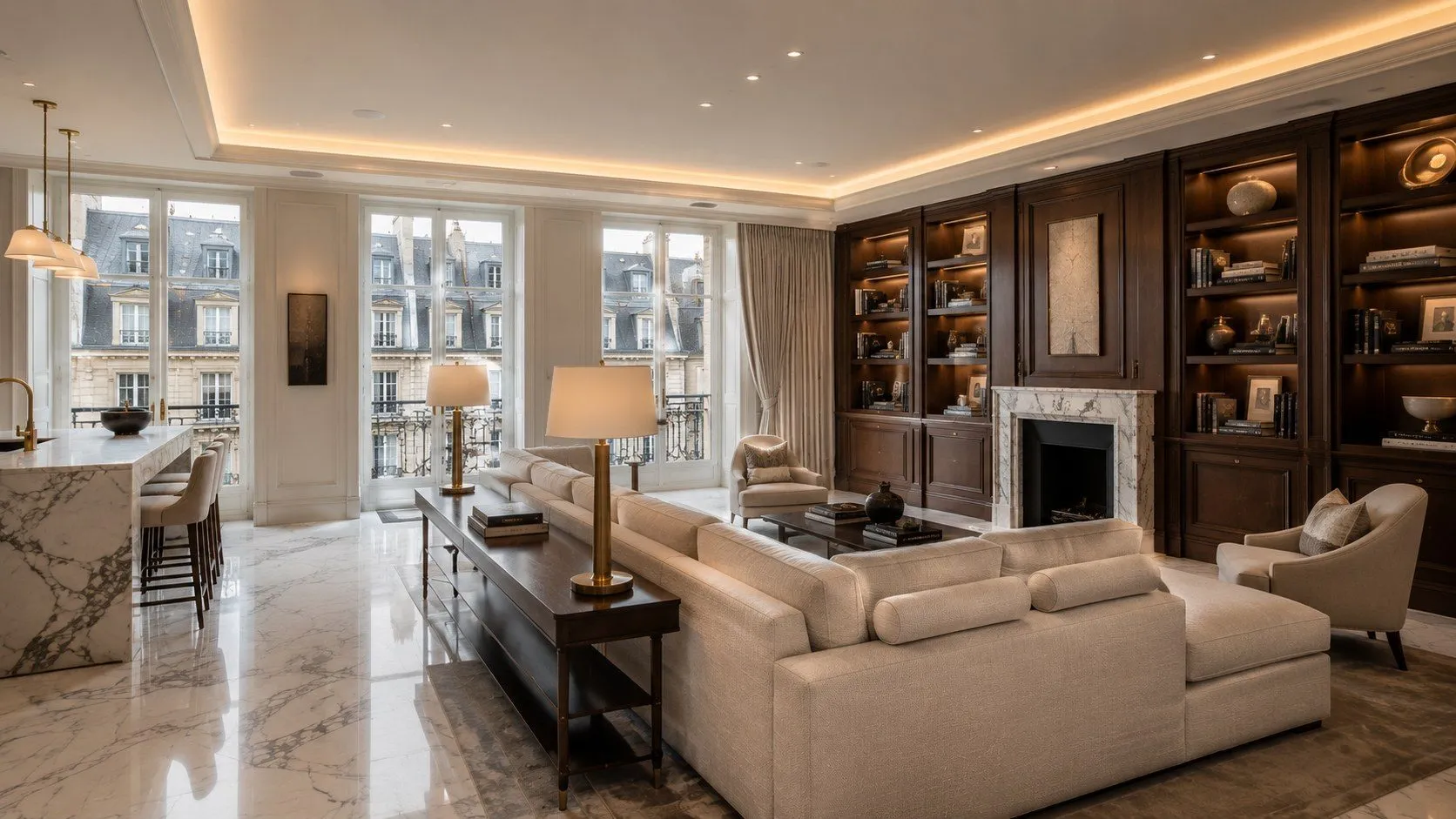
What makes a builder a "luxury" builder
The phrase "luxury builder" is used loosely. Almost any firm operating in a prime London postcode will describe its work as luxury, but the label is meaningless without capability behind it. A genuine luxury home builder is defined not by the addresses it works at but by what it can reliably deliver: finishes executed to a tolerance most contractors cannot hold, a supply chain of specialist fabricators it has worked with for years, and the project management discipline to bring all of it together without the programme slipping or the budget drifting.
In practice, the difference shows up in the detail. The shadow gap that runs true across an entire run of bespoke joinery. The book matched stone whose veining flows seamlessly from one slab to the next. The lighting that has been designed and commissioned, not simply installed. None of this happens by accident, and none of it happens because a firm is expensive. It happens because the builder has the craftsmanship, the relationships and the senior oversight to make it happen: every time, not occasionally.
What luxury construction actually involves in prime London
High end residential construction in central London is a different discipline from building elsewhere. The specification is more demanding, bespoke cabinetry, imported natural stone, hand finished plaster, integrated audiovisual and climate systems, and often a basement excavation or structural reconfiguration beneath a building that may be a century or more old. Each of these packages carries long lead times and narrow tolerances, and each has to be sequenced so that no trade undoes the work of another.
The mechanical and electrical element is frequently underestimated. A modern prime home integrates heating, cooling, ventilation, lighting control, security, networking and entertainment into a single coordinated system that must be designed early and commissioned properly at the end. A luxury builder treats M&E as a core discipline from the first programme, not as a finishing trade squeezed in once the decorating is underway. When it is left late, it is the single most common cause of delay and disappointment on otherwise excellent projects.
The Mayfair factor: building in a prime postcode
Building in Mayfair, Knightsbridge or Belgravia adds a layer of complexity that has nothing to do with the house itself. Many of these properties are listed or sit within conservation areas, which constrains what can be altered and dictates how. Access is often difficult: narrow streets, restricted parking, tight delivery windows and neighbours within feet of the works on every side. Party wall agreements, considerate constructor obligations and local authority relationships are not optional extras, they determine whether a project runs smoothly or becomes a source of ongoing friction.
A luxury builder experienced in these postcodes plans for all of it before work begins: scheduling deliveries to avoid congestion, managing waste removal discreetly, maintaining the property's frontage and protecting the relationship with neighbours throughout. This logistical fluency is invisible when it works and painfully obvious when it does not. It is one of the clearest markers separating a builder who genuinely operates in prime central London from one who simply quotes for work there.
Craftsmanship and the specialist supply chain
The finishes that define a luxury home are produced by specialists, joinery workshops, stone fabricators, metalworkers, plasterers and decorative finishers, and the quality of the result depends heavily on the builder's relationships with them. A contractor who has worked with the same joinery workshop for a decade has production scheduling visibility, quality assurance and trust that a contractor procuring afresh on every job simply cannot match. When lead times extend, as they routinely do on bespoke packages, those established relationships are what protect the programme.
This is why the best luxury builders behave less like procurement intermediaries and more like the conductors of a small, trusted network of makers. The value is not only in the construction management; it is in knowing precisely who to call, what they are capable of, and how to brief them so the architect's and designer's intent survives the journey from drawing to installation intact.
What luxury construction costs, and how long it takes
Prime residential construction costs in central London vary with specification, structural work and finishes, and have no fixed upper limit at the very top end; Crown Building's published tiers, net of VAT, are Premium £175 to £250, Luxury £250 to £400 and Ultra Premium £400 and above. Private residence projects in the best postcodes frequently exceed £1 million. Construction costs across the industry continue to rise, and Crown Building works to stay competitive and in line with industry costs. Programmes for a substantial refurbishment usually run nine to eighteen months once design, consents and procurement are accounted for. These are broad guides only: every prime project is genuinely bespoke. For a fuller breakdown, see our guide to luxury refurbishment costs in London, and for help judging the complexity of your own project, our Project Assessor gives an instant, no cost assessment.
How Crown Building approaches luxury home building
Crown Building has delivered more than 50 projects since 2013, including prime residential work across Mayfair, Knightsbridge, Belgravia, Chelsea, Hampstead and St John's Wood, the largest a £7m new build private residence on The Bishops Avenue, Hampstead. Every project has a dedicated team behind it, with senior management on site rather than managing from a dashboard, and the team you meet at the outset stays with the project through to handover rather than passing it to a junior manager once the contract is signed.
We provide transparent, fully itemised pricing and a detailed programme at tender stage, work with a trusted network of specialist joiners, stone fabricators and finishers, and manage the logistics of building in prime postcodes as a core discipline rather than an afterthought. You are welcome to visit completed work and speak directly with past clients before making any decision.
If you are planning a luxury residential project in London, call us on 020 3675 3999 or book a free consultation here.
Planning a luxury project?
Crown Building offers a free initial consultation: no cost, no commitment. Speak to our senior team about your project today.
Book a Free ConsultationFrequently asked questions
What is the difference between a luxury builder and a general contractor?
A luxury builder is defined by capability, not postcode: established relationships with specialist joinery and stone fabricators, fluency in conservation and party wall procedures, integrated management of high-end mechanical and electrical systems, and senior-led project management present on site throughout. A general contractor may build competently but rarely carries the supply chain, finishing standards or programme discipline that prime residential work demands.
How much does luxury construction cost in London?
Prime residential construction and refurbishment costs in central London vary with specification and have no fixed upper limit at the very top end. Crown Building's published tiers, net of VAT, are Premium £175 to £250 per square foot, Luxury £250 to £400 and Ultra Premium £400 and above. Construction costs across the industry continue to rise, and Crown Building works to stay competitive and in line with industry costs. Whole-house projects in Mayfair, Knightsbridge and Belgravia frequently exceed £1 million. Crown Building provides transparent, fully itemised pricing at tender stage rather than indicative figures.
Which areas of London does Crown Building work in?
Crown Building delivers luxury residential projects across prime central and north-west London, including Mayfair, Knightsbridge, Belgravia, Chelsea, Hampstead and St John's Wood, alongside selected projects in Dubai and Europe. We are an approved contractor for The Crown Estate at Regent's Park and have worked on the Grosvenor, Cadogan and Portman estates.