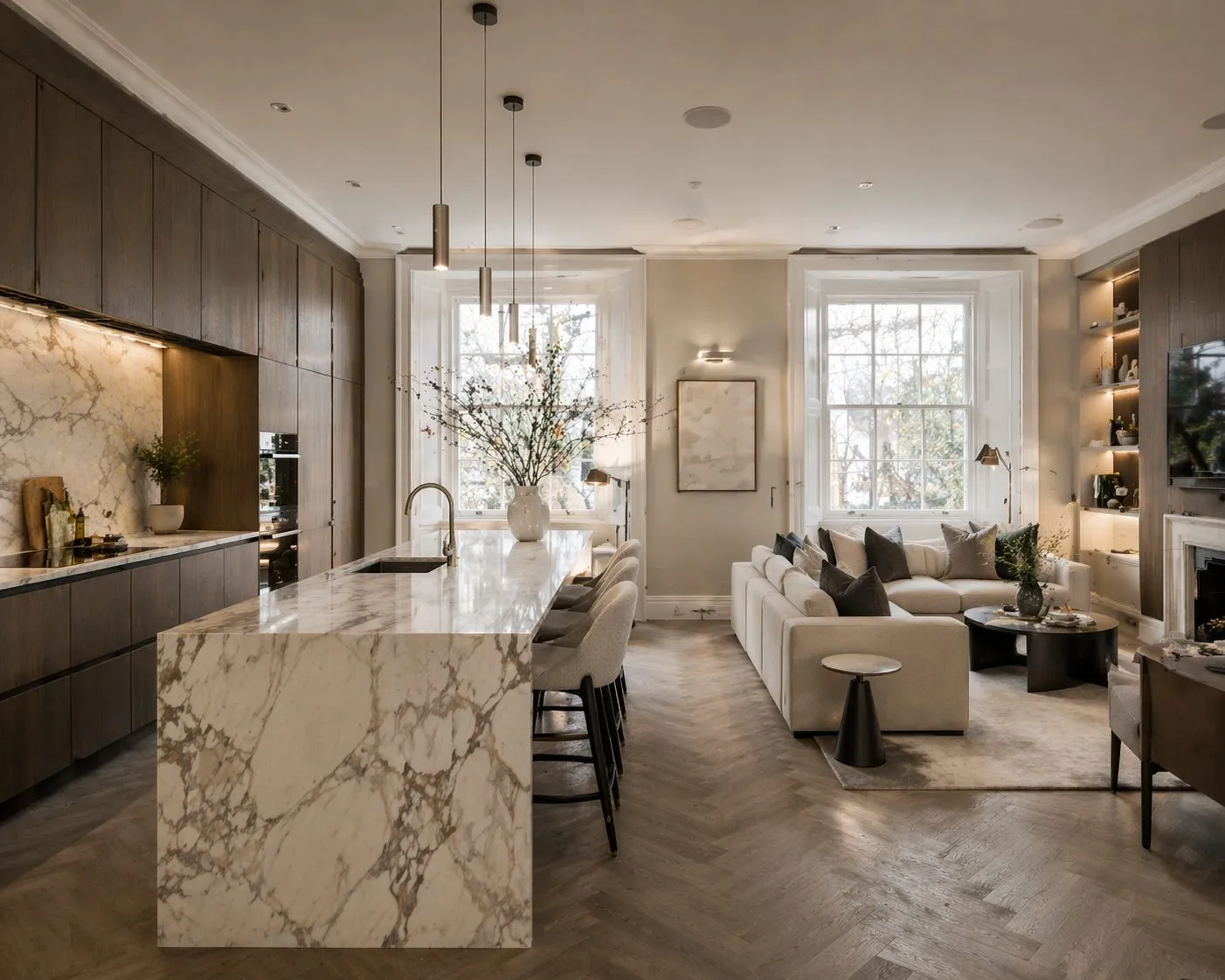
Private residence refurbishment, one accountable contract
Refurbishment is the core of Crown Building's workload. Our published Chelsea case study: a 3,014 sq ft private residence transformation at £365 per square foot (£1.1m), and our Mayfair lateral apartment at £452 per square foot (£1.9m) show how specification and location shape cost at the top of the market, both delivered on locked programmes with itemised cost control.
We do not operate at volume. We compete on execution. Meticulous programming, a trusted specialist supply chain and senior management present on site throughout are the baseline for every commission we accept in London. The standard does not change with the scale of the project.
What a Crown refurbishment includes
A Crown refurbishment typically covers structural reconfiguration and extensions, complete mechanical and electrical renewal, basement additions where the brief calls for them, with BS 8102 waterproofing design specified from the outset rather than retrofitted, and the bespoke joinery and interiors that define the finished home, as design and build or contractor only, with transparent itemised pricing from tender.
What separates a prime refurbishment from an ordinary one is rarely visible in the brochure and always visible in the house: stone whose veining flows slab to slab, joinery that sits true a decade later, services commissioned rather than merely installed, and a programme that ends when we said it would. Our senior team publishes honest cost guidance, see the refurbishment cost guide below, because clients who understand the numbers make better decisions, and better clients make better buildings.
What you find when you open up a period property
This is the difference between refurbishment and new build, and it is the one that unsettles clients most. On a cleared plot you know what you are building on. In a London period property you are working on top of a hundred and fifty years of other people's decisions, and some of them only become visible once the plaster is off.
What we routinely find: wiring that predates modern regulation, lead or unlined pipework, joists notched almost through by a previous heating installation, structural openings formed without any visible support, damp behind sound looking finishes, and asbestos in artex, textured coatings, floor tiles and boiler flues in anything built or altered before 2000. None of these are unusual and none should stop a project. What matters is whether your contractor priced for the possibility or intends to discover them at your expense.
We handle this with provisional sums stated openly at tender rather than buried. Where a risk cannot be quantified until we open up, it is named, given a realistic allowance and reconciled against actual cost, not treated as a variation to be argued about in month four. Ask any contractor how they have priced the unknowns before you compare their bottom line, because the lowest tender is very often the one that has simply left them out.
Living in it, or moving out
Almost every refurbishment client asks whether they can stay in the house, and the honest answer is that you usually can, but it will cost you time and money to do so. A phased refurbishment where you occupy part of the property means temporary protection and dust screening that has to be built and rebuilt, services kept live in zones, trades working around your household rather than through it, and restricted hours. It is common to add a third or more to the programme.
Vacant possession lets us work the whole house at once, run trades in parallel rather than in sequence, and strip out without protection regimes. On a whole house project the rent on somewhere else is frequently less than the cost of the phasing. We will model both for you honestly at tender rather than assuming, because the right answer depends on the property, the scope and your circumstances rather than on what is convenient for us.
What needs consent, and what does not
Internal alterations to an unlisted house generally do not need planning permission, which surprises people. What they do need is building regulations approval, and that covers far more than most clients expect: structural openings, new drainage, electrical work, insulation, fire separation between floors, means of escape and ventilation. A refurbishment signed off properly is worth considerably more at resale than one that was not, and a missing completion certificate will surface in the buyer's searches years later.
Listed buildings are a different matter entirely. Listed building consent is required for internal work as well as external, it applies to fabric most people would consider cosmetic, and carrying out work without it is a criminal offence rather than a planning breach you can regularise afterwards. Conservation areas restrict what you can do externally. Flats and mansion blocks add a further layer: freeholder consent, a licence to alter, and often a managing agent with their own conditions. We establish which of these apply before pricing, because a programme built on the assumption that consent is a formality is a programme that will slip. Our listed building work is set out separately.
Where a refurbishment budget actually goes
Clients tend to arrive focused on kitchens, bathrooms and finishes, which are the visible half. On a full refurbishment at this level the invisible half routinely costs more. Complete mechanical and electrical renewal, structural alterations, underfloor heating, insulation and acoustic separation, and the making good that follows all of it, will typically absorb a larger share of the contract sum than everything you can see when the dust sheets come off.
This is why our published tiers span such a wide range, Premium at £140 to £210 per sq ft, Luxury at £210 to £325, and Ultra Premium from £325 to £600 and above, all net of VAT. The tier is set less by the finish you choose than by how much of the building behind it has to be renewed. A property with sound services and no structural work can be finished to a very high standard within the middle tier. A house needing full rewire, replumb, structural openings and acoustic upgrade will reach the upper tier before you have chosen a single tap.
Areas we serve
We refurbish across prime central London, Mayfair, Chelsea, Knightsbridge, Kensington, Hampstead, St John's Wood, and throughout our wider coverage area. You can see our full coverage, London within the M25 and a fifteen mile radius of our Watford headquarters, on our areas we cover page.
Speak to us about your refurbishment
If you are planning a refurbishment, basement or new build in London, call us on 020 3675 3999 or book a free consultation here. Every enquiry is handled by a director.
Frequently asked questions
Where is Crown Building based?
Crown Building's registered office is at Unit 324-B, The Wenta Business Centre, Colne Way, Watford, WD24 7ND. We work throughout London within the M25 and across Hertfordshire and the Home Counties.
Which areas around London do you cover?
Everywhere in our coverage area: all of London within the M25, Hertfordshire, and the prime corridors of Surrey.
What does a luxury refurbishment cost in London?
Our published tiers: Premium £140 to 210/sq ft, Luxury £210 to 325/sq ft, Ultra Premium £325 to 600+/sq ft (net of VAT). Our Chelsea project delivered at £365/sq ft; Mayfair at £452/sq ft. Every tender is a fully itemised contract sum.
Can I stay in the house during the refurbishment?
Usually yes, but phasing the work around an occupied household commonly adds a third or more to the programme, because protection and dust screening have to be built and rebuilt, services kept live in zones, and trades run in sequence rather than in parallel. On a whole house project the cost of renting elsewhere is frequently less than the cost of the phasing. We model both at tender.
Do I need planning permission to refurbish inside my house?
Internal alterations to an unlisted house generally do not need planning permission, but they do need building regulations approval, covering structural openings, drainage, electrics, insulation, fire separation and ventilation. Listed buildings are different: listed building consent is required for internal work as well as external, and proceeding without it is a criminal offence. Flats and mansion blocks also need freeholder consent and usually a licence to alter.
What happens if you find problems once work starts?
Period properties routinely conceal outdated wiring, notched joists, unsupported structural openings, damp and asbestos in pre-2000 materials. We price these as provisional sums stated openly at tender, with a realistic allowance reconciled against actual cost, rather than treating them as variations to be argued about mid contract. The lowest tender is often the one that has left the unknowns out.
Planning a project in London?
Crown Building offers a free initial consultation: no cost, no commitment. Speak to our senior team about your project today.
Book a Free Consultation