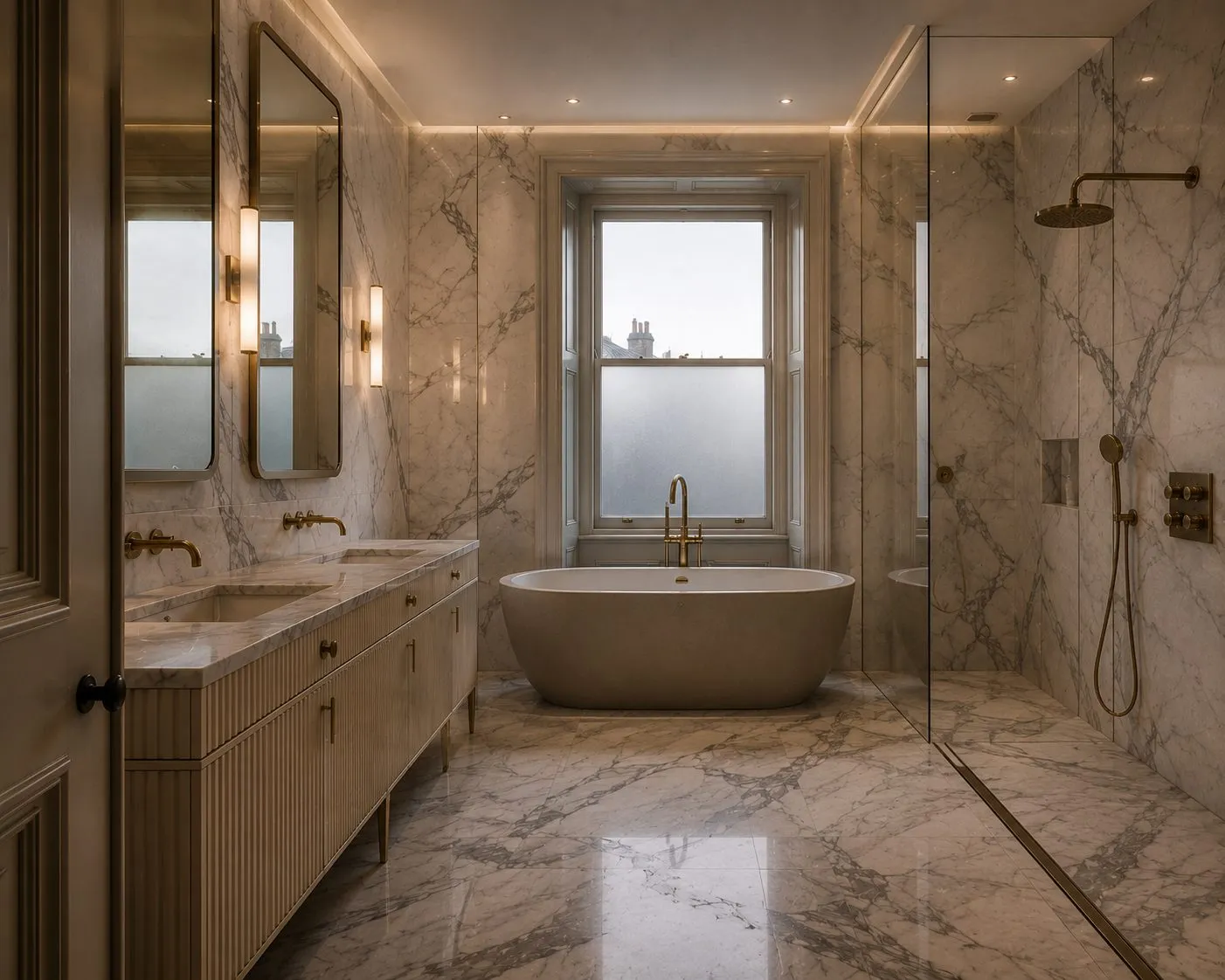
Prime residential construction in Kensington
Crown Building works at the top of the London market, and Kensington is core territory for our team. The projects in our published case studies were delivered under exactly the constraints that define this part of London. Protected fabric, exacting consents, discreet site conduct and clients who judge the result at touching distance.
Every project has a dedicated team behind it. Meticulous programming, a trusted specialist supply chain and senior management present on site throughout are the baseline for every commission we accept in Kensington. The standard does not change with the scale of the project.
What we build in Kensington
Our residential work spans the full scope of high end building. We deliver architecturally distinctive new build homes, private residence refurbishments and structural reconfigurations, single and multistorey extensions, basement excavations, listed and period property works, and the bespoke joinery and interiors that define a finished home. Each project is delivered as design and build or contractor only, with Crown appointed as your prime residential main contractor, and transparent, itemised pricing from the outset. Commercial occupiers are served by the same teams through our commercial fit out division, and clinical and wellness premises through our healthcare and specialist environments team.
Between Kensington Square, Edwardes Square and the Phillimore estate sits some of London's most valuable and most protected housing. The Royal Borough's basement policy is among the strictest in the country, listed building consents are the norm rather than the exception, and construction traffic management plans are enforced to the letter. This is an environment that rewards our way of working: exhaustive preconstruction, structural and waterproofing specialists we have used for years, and site conduct that keeps neighbours and the council onside for the duration of a two year programme.
Areas we serve
We work throughout Kensington, Kensington Square, the Phillimore and De Vere estates, Edwardes Square and Holland Street. Plus South Kensington, Earl's Court and the Holland Park borders. You can see our full coverage, London within the M25 and a fifteen mile radius of our Watford headquarters, on our areas we cover page.
If your home is a flat, you may have no permitted development rights at all
This is the single most common misunderstanding we encounter in Kensington, and it is set out plainly in the Royal Borough's Local Plan: while dwellinghouses have permitted development rights, buildings such as mansion blocks, often in multiple ownership, do not. A high proportion of the borough's dwellings are flats. If yours is one of them, the question is not whether your alteration falls within permitted development but whether it needs planning permission, freeholder consent under a licence to alter, or both.
Add to that the borough's conservation area coverage. Thirty eight conservation areas cover more than seventy three per cent of the Royal Borough, and the Kensington Conservation Area is the largest of them, formed in 1976 from earlier designations and extended in 1982 and 1994. Within conservation areas the Council requires full planning applications rather than outline ones, so there is no cheap way to test the principle of a scheme before committing to detailed drawings.
Street level Article 4 controls, and why the address matters more than the postcode
Beyond the borough wide directions, the Royal Borough maintains a street by street schedule of conservation area Article 4 directions running to more than two hundred separate street and property range entries, with directions dating from 1969 through to 2012. They control what the Council describes as small scale changes to the outside of houses that would otherwise harm the historic character: changing windows, front doors, removing or rebuilding boundary walls, roof coverings and other works, often to front elevations.
Kensington streets appearing on that schedule include Abingdon Road, Essex Villas, Berkeley Gardens and Brunswick Gardens among many others. The practical point is that two houses a few hundred metres apart can sit under entirely different control regimes, so the consent position has to be established for your specific address rather than assumed from the area. We check it before pricing, and the Council recommends confirming any interpretation with its planning team directly.
Kensington's stock, from Georgian villa to 1870s mansion flat
The Council's own appraisal describes Kensington as many solidly developed streets with a highly urban form and very little green space, which took the shape we see today largely between the early and late Victorian periods. The late Georgian and early Victorian suburban villas that preceded them were gradually swept away, some as late as the 1960s and 70s. The conservation area divides into ten areas of differing character: speculative terraces in Hillgate Village built small and for the working classes, and elsewhere houses built for wealthy families, with the Pitt, Campden House and Phillimore Estates containing particularly good examples.
Around it sit the grand terraces and intimate mews of Queen's Gate, spanning the late Georgian period to the mid twentieth century in London stock and red brick, stucco, stone and terracotta, and the Kensington Court area, which the Council says shows the extraordinary change in taste that took place in London in the 1870s and 1880s. Each of those types behaves differently once you open it up, and the borough's mews in particular, originally stable blocks and generally of modest construction, rarely tolerate the structural assumptions that work on a stuccoed terrace.
Speak to us about your Kensington project
If you are planning a refurbishment, basement or new build in Kensington, call us on 020 3675 3999 or book a free consultation here.
Frequently asked questions
Where is Crown Building based?
Crown Building is a prime residential contractor working throughout London. Its London projects include a £7m five level private residence on The Bishops Avenue, Hampstead, a £1.9m apartment in Mayfair and a £1.1m residence in Chelsea. The head office is at Unit 324-B, The Wenta Business Centre, Colne Way, Watford, WD24 7ND, and we also work across Hertfordshire and the Home Counties.
Which areas around Kensington do you cover?
We work throughout W8 including Kensington Square, the Phillimore estate, Edwardes Square and Holland Street, plus South Kensington and Earl's Court.
Can you deliver basement projects in Kensington?
Yes. We deliver structural basement excavations with certified waterproofing (DELTA Membrane approved and Mapei registered) and manage the Royal Borough's basement policy requirements, party wall awards and construction traffic plans as part of the service.
Planning a project in Kensington?
Crown Building offers a free initial consultation: no cost, no commitment. Speak to our senior team about your project today.
Book a Free Consultation