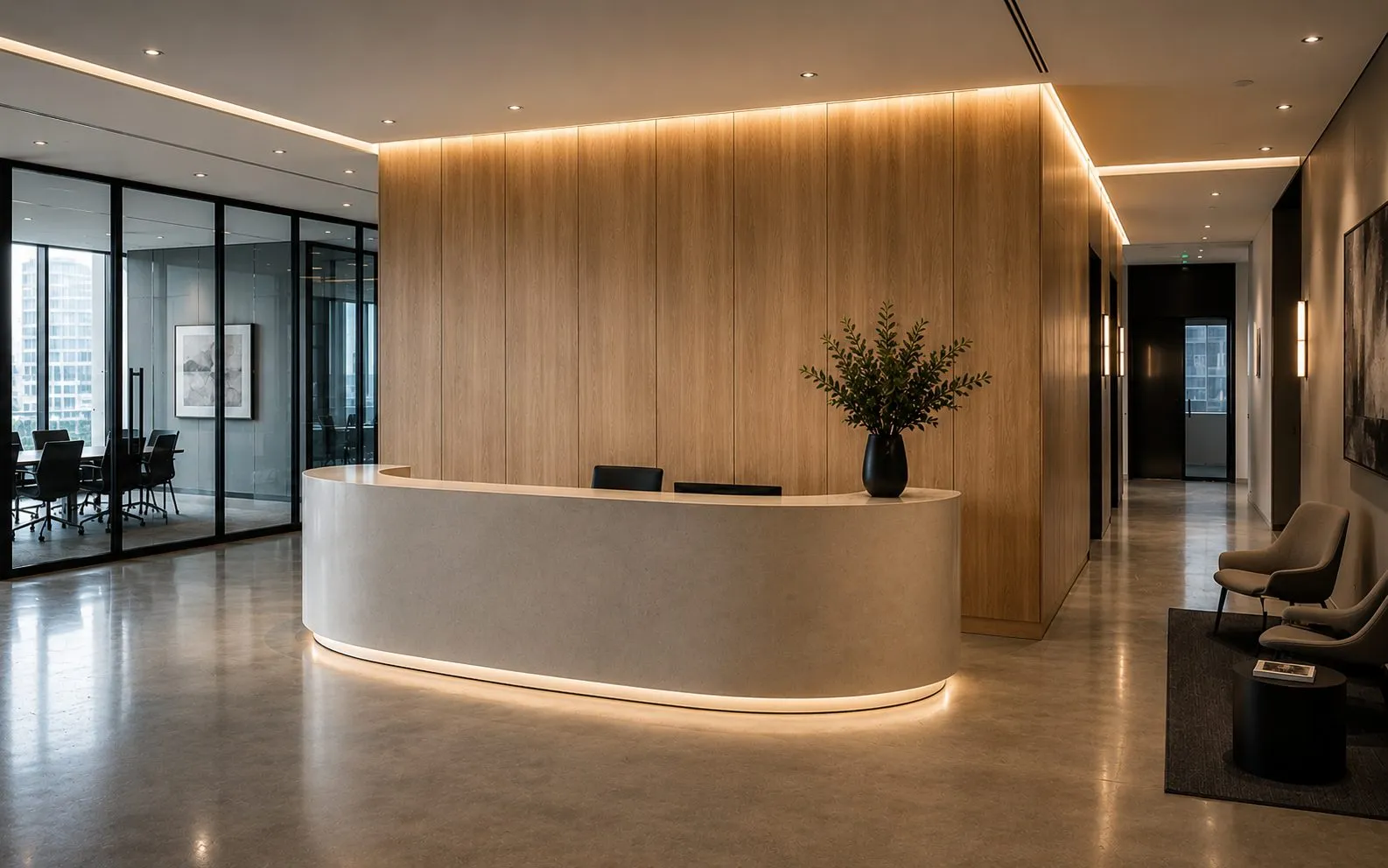
Commercial delivery with residential craft
Commercial clients come to us for a particular combination: the finish quality of a private residence and the programme certainty of an institutional contractor. Our published Grade A refurbishment and Stanmore fit out case studies, and the live Canary Wharf Cat B, document both.
We do not operate at volume. We compete on execution. Meticulous programming, a trusted specialist supply chain and senior management present on site throughout are the baseline for every commission we accept in London. The standard does not change with the scale of the project.
Workspace built to residential standards
The scope covers full strip out and Cat A reinstatement, Category B fit outs, feature receptions and client suites, boardrooms and collaborative space, healthcare and clinical environments, and bespoke joinery throughout, coordinated with building management, landlord licences and lease obligations.
Commercial programmes are governed by lease events, not seasons, and the cost of overrunning one is measured in rent, dilapidations and reputations. Our delivery model is built accordingly: locked programmes, phased and out of hours working in occupied buildings, protection and noise regimes agreed with building management before mobilisation, and itemised commercial terms without provisional sum ambushes. See our dedicated City & Canary Wharf page for the current live programme.
Office fit out in Watford and Hertfordshire
Our head office is in Watford, so Hertfordshire is our home market rather than an outpost of a London operation. The commercial team sits in the same building as the residential one, which means an office fit out in Watford, St Albans or Borehamwood gets the same directors, the same specialist supply chain and the same programme discipline as a City scheme, without central London preliminaries and travel time loaded on top of the contract sum.
The clearest evidence sits six miles from our door. We delivered a 4,200 sq ft commercial office fit out in Stanmore HA7 at a contract value of £675,000: bespoke joinery throughout, full audio visual integration and a premium specification carried from the reception through to the back of house. It is a Hertfordshire project delivered to a central London standard, and it is the benchmark we work to across the county.
We cover Watford, Bushey, Radlett, Borehamwood, St Albans, Rickmansworth, Chorleywood, Stanmore, Northwood and Hemel Hempstead for Category A and Category B fit outs, office refurbishment, strip out and reinstatement, and landlord works ahead of a letting. Programmes are built around lease events and, where the building stays occupied, around your people: phased working, agreed noise windows and out of hours access are standard rather than a variation. Our Watford and Hertfordshire page sets out the wider local coverage.
Areas we serve
We deliver commercial projects across central London: the City, Canary Wharf, the West End, and throughout the M25 corridor including our Hertfordshire home market. You can see our full coverage, London within the M25 and a fifteen mile radius of our Watford headquarters, on our areas we cover page.
Category A, Category B, and the gap between them
Commercial fit out is described in two categories and the distinction determines who pays for what. Category A is the landlord's work: raised floors, suspended ceilings, basic mechanical and electrical distribution, fire detection and finishes to a lettable standard. It produces a space that is complete but generic. Category B is the occupier's work: the actual layout, the meeting rooms, the tea points, the joinery, the branding, the AV and the reconfiguration of services to suit how the business works.
The cost overrun on most fit outs happens in the gap between the two. A Category A specification that looks complete on paper often has to be partly undone to accommodate Category B: ceiling grids reset, sprinkler heads relocated, ductwork rerouted, floor boxes moved. That work is rarely in either budget at the outset. On a space that has already been fitted out and is being taken second hand, the equivalent risk is the dilapidations position at the other end, where the lease may require reinstatement of everything now being installed.
The practical answer is to read the licence to alter and the lease reinstatement provisions before the design is fixed, not after. What can be left in place at lease end, and what must come out, changes the sensible specification substantially, and it is far cheaper to design around than to negotiate later.
Landlord consent is a separate process with its own timescale
In a multi let building the occupier does not simply commission the work. Alterations require a licence to alter from the landlord, which is a legal document negotiated between solicitors, usually requiring drawings, specifications, the contractor's details, evidence of insurance and often a rent deposit or bond against reinstatement. Six to eight weeks is normal and longer is common where the landlord's surveyor raises comments.
Alongside it sits the building manager's own regime, which is operational rather than legal and is where most programmes actually slip. Expect a permit to work system, induction for every operative, restricted delivery windows, booked goods lift slots with a limit on how long the lift can be held, out of hours working for anything noisy or anything affecting common parts, and rules on hot works, isolations and fire alarm inhibits. On a tower these are not negotiable and they are not fast.
Where the building is occupied, the constraint tightens further. Noisy work is typically confined to evenings and weekends, deliveries to early mornings, and any work touching the base build fire, sprinkler or air conditioning systems has to be scheduled around the building's own maintenance windows. A programme that assumes continuous daytime working in an occupied Grade A building will be wrong by a wide margin, and the error is almost always in the same direction.
What actually drives the programme
Three things set the length of a commercial fit out and none of them is the construction itself. The first is consents: licence to alter, building regulations, and where the work affects the exterior or a change of use, planning. The second is long lead items, principally bespoke joinery, specialist glazing and partitioning, feature lighting and any plant that has to be ordered rather than taken from stock. The third is commissioning and handover, where the mechanical and electrical systems have to be tested, balanced and witnessed, the fire strategy demonstrated, and the building manager satisfied before the space can be occupied.
Compressing a fit out therefore means starting the consents and the procurement earlier, not adding labour at the end. Adding operatives to a floorplate that already has three trades working in the same ceiling void reduces output rather than increasing it, and on a project measured in weeks that is an expensive lesson.
The handover documentation is worth planning for at the start rather than assembling at the end. Operation and maintenance manuals, test certificates, as built drawings, asset registers and the fire safety information required under the Building Regulations all take time to compile, and a landlord will frequently withhold final sign off until they are complete. On an occupier's programme driven by a lease commencement date, that is not a detail.
Discuss your fit out programme
If you are planning a refurbishment, basement or new build in London, call us on 020 3675 3999 or book a free consultation here. Every enquiry is handled by a director.
Frequently asked questions
Where is Crown Building based?
Crown Building's registered office is at Unit 324-B, The Wenta Business Centre, Colne Way, Watford, WD24 7ND. We work throughout London within the M25 and across Hertfordshire and the Home Counties.
Which areas around London do you cover?
Across London and the M25 corridor: the City, Canary Wharf, the West End and Hertfordshire, with published projects in Stanmore and Docklands.
Do you carry out office fit outs in Hertfordshire?
Yes. Our office is in Watford and Hertfordshire is our home market. Our published fit out in Stanmore HA7 is a 4,200 sq ft scheme at a £675,000 contract value, with bespoke joinery and full audio visual integration, and we work across Watford, St Albans, Radlett, Borehamwood, Rickmansworth and the surrounding towns for both Category A and Category B work.
Do you work in occupied buildings?
Yes, phased and out of hours programmes in occupied buildings are standard, coordinated with building management: logistics, protection, noise windows and lift allocations are agreed at preconstruction.
Planning a project in London?
Crown Building offers a free initial consultation: no cost, no commitment. Speak to our senior team about your project today.
Book a Free Consultation