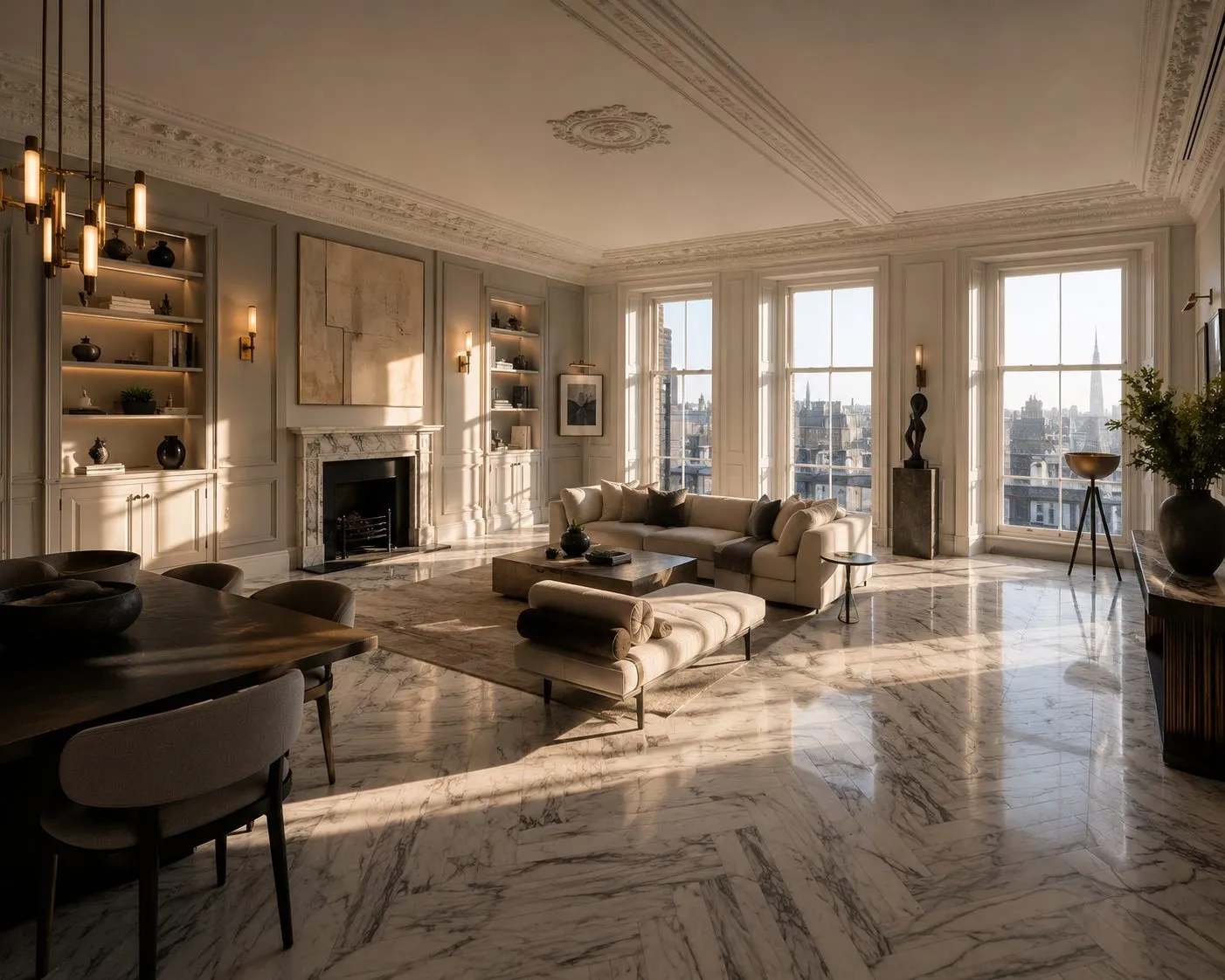
A main contractor built for prime London
Since 2013 we have delivered prime residential projects from Watford to Mayfair on one operating principle: we do not compete at volume, we compete on execution. Published case studies across Mayfair, Chelsea, St John's Wood, Hampstead, Highgate and Mill Hill document the standard. The largest is a £7m private residence, design and build, on The Bishops Avenue, Hampstead, designed and constructed by Crown Building on a single contract.
We do not operate at volume. We compete on execution. Meticulous programming, a trusted specialist supply chain and senior management present on site throughout are the baseline for every commission we accept in London. The standard does not change with the scale of the project.
How we operate as your main contractor
As main contractor we deliver new build homes, private residence refurbishments, basement excavations and bespoke joinery, design and build or contractor only, under JCT, NEC or RIBA forms, with itemised contract sums and locked programmes.
Appointing a contractor is the highest consequence decision in any project, and the market rewards knowing how to make it: financial stability that absorbs a variation without a dispute, party wall and consent management without drama, protection regimes and site conduct that keep neighbours and freeholders onside for two years. Our candid guide to choosing a prime residential contractor, written by our senior team, sets out the questions we believe every client should ask, including of us.
What a prime London contract costs
Cost per square foot is the only figure worth comparing between contractors, and it is the one least often published. Our contracts have run from £120,000 to £7m since 2013, with team capacity to £25m, but the range tells you nothing on its own. What moves the rate is access, constraint and specification, in that order. A property with a rear lane and a skip permit is a different job from a top floor flat in a mansion block where every pallet arrives through a shared entrance under porter supervision.
Two completed contracts as real anchors rather than a brochure range. In Chelsea SW3 we delivered a complete interior transformation of a period property, 3,014 sq ft finished to ultra premium specification, at a contract sum of £1.1m, or approximately £365 per sq ft. In Mayfair W1 we refurbished the entire top floor of a landmark mansion block, 4,200 sq ft to the same standard, at £1.9m, or approximately £452 per sq ft.
The same specification, a difference of £87 per sq ft. Almost all of that gap is logistics and constraint rather than finish: restricted delivery windows, a single goods lift shared with residents, protection regimes running for the full programme, and consent from a freeholder and a managing agent before a single fixing goes into a party structure. When you compare quotations, establish what each contractor has assumed about access before you compare their rates. You can see both projects in full on our Chelsea and Mayfair case studies.
Design and build, or a contractor working to someone else's drawings
This is the decision that determines who carries the risk when the drawings and the building disagree, and on a project of any size they will disagree at some point. Under a traditional appointment your architect designs, we price and build, and the gap between the two is yours. When a detail proves undeliverable as drawn, the conversation about who pays for the redesign is a conversation between your consultants and your contractor, with you in the middle of it.
Under design and build, that gap is ours. We take the design responsibility and the construction responsibility on a single contract, which means a buildability problem is ours to solve rather than yours to arbitrate. Our largest project to date, a £7m private residence on The Bishops Avenue, was delivered this way: one firm accountable for the drawing and the thing built from it.
Neither route is automatically correct. Traditional gives you more direct control of the design and suits clients with a strong architect relationship they want protected. Design and build gives you one accountable party and generally a firmer programme. We work under both, and we will tell you honestly which we think fits your project when we see it.
The programme, and what actually moves it
A whole house refurbishment at this level generally runs nine to eighteen months on site, a new build eighteen months to three years. Those are honest ranges rather than optimistic ones, and the variation within them is rarely caused by the construction itself.
Four things move a prime London programme, and only one of them is on site. Planning and listed building consent, which cannot be compressed by paying more. Party wall awards, where a single unresponsive neighbour can hold a start date for months. Long lead items, particularly stone, bespoke joinery and specialist glazing, which need ordering before you have finished deciding. And client decisions, which is the one nobody warns you about: a fortnight spent choosing a finish in month four becomes a fortnight added to the end. We programme all four explicitly at tender, and we would rather show you a realistic eighteen months than win the work on a twelve we cannot hold.
How the contract protects your money
You are handing a seven figure sum to a building company, and the sensible question is what happens if something goes wrong. We work under JCT, NEC and RIBA forms as standard, never on a letter of intent beyond the earliest enabling works. That gives you a fully itemised contract sum at tender rather than a lump figure, a defined variation procedure so changes are priced before they are built rather than argued after, retention held against defects, and liquidated damages if we overrun.
Ask any contractor you are considering for three things before you appoint them: their last three years of filed accounts, their insurance certificates with the limits visible, and the name of the person who will actually be on your site each week. A contractor who hesitates over any of the three is telling you something. Ask us the same questions. Every enquiry here is handled by a director, and you can use our free Project Assessor for an instant read on scope and complexity before you speak to anyone.
Areas we serve
We operate across all of London within the M25, Hertfordshire and selected Surrey addresses. You can see our full coverage, London within the M25 and a fifteen mile radius of our Watford headquarters, on our areas we cover page.
Appoint a contractor worth the address
If you are planning a refurbishment, basement or new build in London, call us on 020 3675 3999 or book a free consultation here. Every enquiry is handled by a director.
Frequently asked questions
Where is Crown Building based?
Crown Building's registered office is at Unit 324-B, The Wenta Business Centre, Colne Way, Watford, WD24 7ND. We work throughout London within the M25 and across Hertfordshire and the Home Counties.
Which areas around London do you cover?
All of London within the M25, a 15-mile radius of our Watford headquarters, and the prime corridors of Surrey.
What contract forms do you work under?
JCT, NEC and RIBA forms as standard, design and build or traditional contractor only, with a fully itemised contract sum at tender, transparent variations and a locked programme. Every enquiry is handled by a director.
What does a prime London refurbishment cost per square foot?
On completed contracts, approximately £365 per sq ft for a 3,014 sq ft period property in Chelsea and approximately £452 per sq ft for a 4,200 sq ft mansion block floor in Mayfair, both to ultra premium specification. The difference is access and constraint rather than finish. Our contracts have run from £120,000 to £7m since 2013, with team capacity to £25m.
How long does a prime residential project take?
A whole house refurbishment generally runs nine to eighteen months on site and a new build eighteen months to three years. Planning and listed building consent, party wall awards, long lead items such as stone and bespoke joinery, and the speed of client decisions move the programme far more than the construction itself.
Should I appoint you as design and build or contractor only?
Design and build puts the design and the construction on one contract, so a buildability problem is ours to solve rather than yours to arbitrate between consultants. Traditional appointment gives you more direct control of the design and suits a strong existing architect relationship. We work under both and will tell you which we think fits your project.
Planning a project in London?
Crown Building offers a free initial consultation: no cost, no commitment. Speak to our senior team about your project today.
Book a Free Consultation