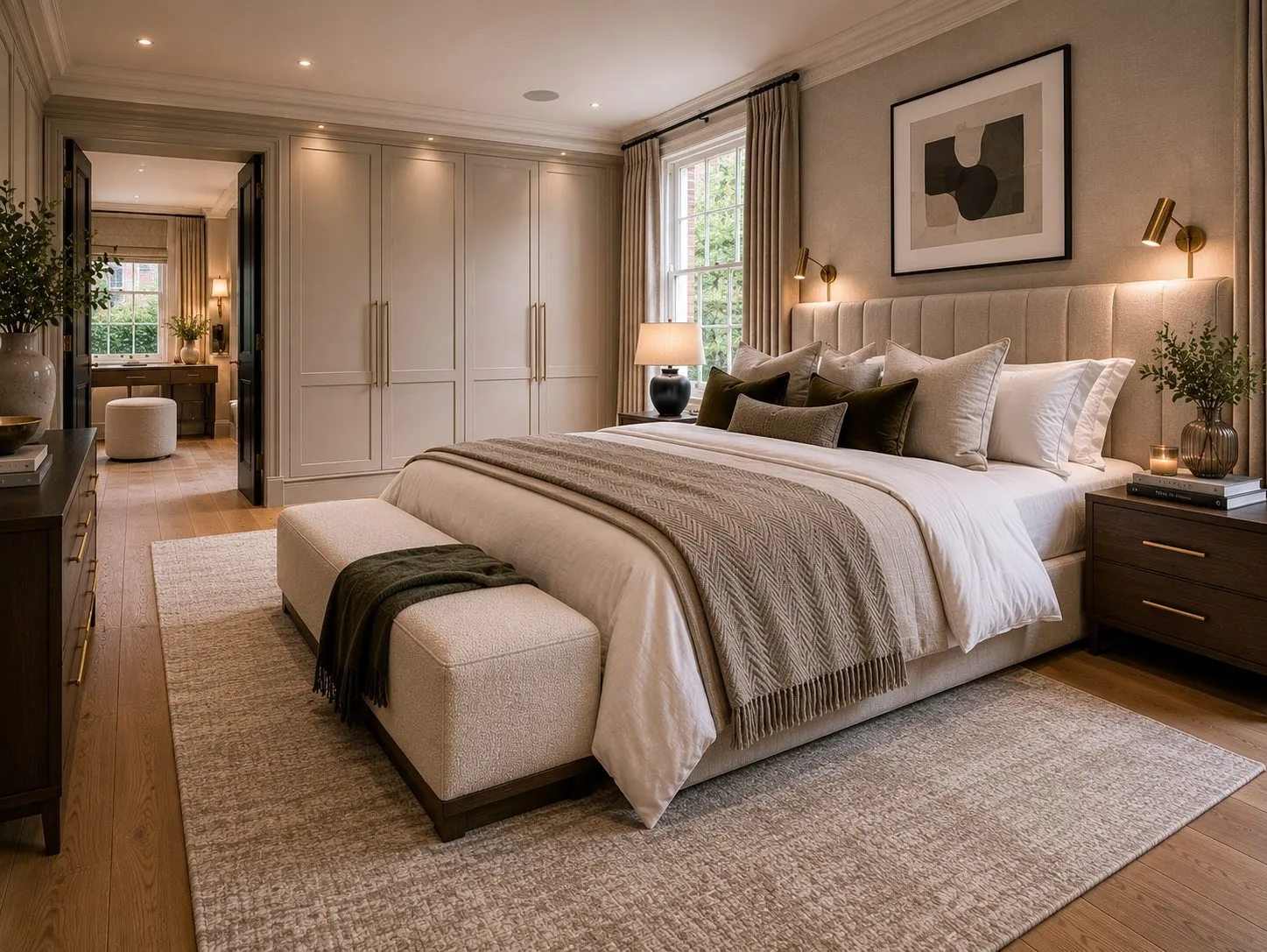
A London prime contractor, minutes from St Albans
Crown Building has been delivering prime residential construction since 2013, and St Albans sits comfortably within the daily operating radius of our Watford headquarters. While much of our work is in the prime central London postcodes, Mayfair, Chelsea, Knightsbridge, Belgravia, our roots, our team and our head office are minutes away. For homeowners in St Albans, that means a contractor working to a genuine prime residential standard, with senior management close enough to be on site whenever the project needs them.
Every project has a dedicated team behind it. The discipline that the best London projects demand, meticulous programming, a trusted specialist supply chain and senior management present on site throughout, is exactly what we bring to a home in St Albans. The standard does not change with the postcode.
What we build in St Albans
Our residential work spans the full scope of high end building. We deliver architecturally distinctive new build homes, private residence refurbishments and structural reconfigurations, single and multistorey extensions, basement excavations, listed and period property works, and the bespoke joinery and interiors that define a finished home. Each project is delivered as design and build or contractor only, with Crown appointed as your prime residential main contractor, and transparent, itemised pricing from the outset. Commercial occupiers are served by the same teams through our commercial fit out division, and clinical and wellness premises through our healthcare and specialist environments team.
St Albans is defined by its period stock: Georgian townhouses along Fishpool Street and George Street, Victorian and Edwardian villas around Clarence Park and Marshalswick, and listed cottages threaded through more than a dozen conservation areas. Work here frequently involves Listed Building Consent, conservation area constraints and party wall negotiations in tight terraces. Procedures we manage as a matter of routine on our central London projects. Where the brief is contemporary, the city's outer roads carry substantial plots well suited to high specification extension and remodelling work.
Areas we serve
We cover the whole of the city and its surrounds: the centre and Fishpool Street quarter, Marshalswick, Jersey Farm, Chiswell Green, Bricket Wood, Park Street and out to Harpenden and Wheathampstead. St Albans is one of the closest cities to our Watford office, which keeps senior management on site consistently. You can see our full coverage, London within the M25 and a fifteen mile radius of our Watford headquarters, on our areas we cover page.
St Albans is still working to a 1994 Local Plan, and that is about to change
This is unusual and it matters. The adopted development plan for the district remains the St Albans District Local Plan Review of 1994, with only its saved policies operative. Policies not saved by the 2007 Secretary of State Direction expired in September 2007.
That position is on the point of changing. The Council confirmed on 25 August 2026 that the Inspectors' Report had been delivered on 21 August, formally closing the examination, and that the report concludes the new Local Plan is sound, legally compliant and capable of adoption subject to the recommended main modifications. No adoption date has been published, so the emerging plan already carries significant weight in decisions while the 1994 policies remain formally adopted.
For anyone planning work here, the practical consequence is that advice written even a few months ago may be aimed at the wrong document, and the Green Belt allowances in particular are changing shape. We check the current position at the point of pricing rather than relying on what applied last time.
Green Belt: the numbers are in guidance, not policy
Over eighty one per cent of the district is Green Belt, some 13,141 hectares. The adopted policy, saved Policy 13, contains no numbers at all: it requires only that any extended or replacement dwelling is modest in scale and visually well integrated with its rural surroundings, and that extensions including garages or outbuildings do not create a building of significantly larger or different character than the original, assessed against the building as constructed or as it stood on 1 July 1948.
The figures sit in the Council's 2004 Supplementary Planning Guidance on residential extensions and replacement dwellings in the Green Belt. For side and rear extensions it gives a range of 90 to 180 cubic metres of additional cubic content, or a 20 to 40 per cent increase in floorspace subject to a maximum increase of 300 cubic metres, whichever of the two ranges is the greater. Where you sit in that range depends on how the scheme performs against the guidance criteria. For other extension types the guidance declines to give figures and states that what is permitted will generally be considerably smaller.
The emerging plan replaces this with a tiered table linked to design quality, running from under 90 cubic metres for a poorly designed scheme to above the range for one judged very well designed. Since that plan is capable of adoption but not yet adopted, both positions are worth understanding when a scheme is being shaped.
Archaeology: the constraint that defines building in St Albans
St Albans is the only district we work in that employs its own District Archaeologist. Hertfordshire County Council's shared historic environment service explicitly excludes the district for that reason. There are three categories of protected archaeology here: scheduled monuments, archaeological sites for local preservation under saved Policy 110, and archaeological sites subject to recording conditions under saved Policy 111, the latter covering around thirty seven sites including the areas around Verulamium and Beech Bottom and the Saxon and medieval town.
The hard trigger is in the Council's householder validation checklist. An archaeological desk based assessment is required for all applications where groundworks are proposed within any of those three categories. And where proposals include new basements, extensions to basements or other extensive groundworks, the results of an archaeological evaluation must be included with the application, not merely promised. A Written Scheme of Investigation may also be required, and since September 2020 the Council charges a fee where an application is submitted invalid and not corrected within fourteen days.
For a basement or a substantial extension in or near the historic core, that evaluation is a programme item with a lead time, not a form to sign. We identify it at feasibility. The district also has over 800 listed buildings, where the whole building is protected inside and out, and structures in the grounds pre-dating July 1948 including boundary walls and gates may be curtilage listed.
Speak to us about your St Albans project
If you are planning a build, refurbishment or extension in St Albans, call us on 020 3675 3999 or book a free consultation here. Our head office is Unit 324-B, The Wenta Business Centre, Colne Way, Watford, WD24 7ND.
Frequently asked questions
Where is Crown Building based?
Crown Building's head office is at Unit 324-B, The Wenta Business Centre, Colne Way, Watford, WD24 7ND. We work throughout London within the M25 and across Hertfordshire and the Home Counties.
Which areas around St Albans do you cover?
We work across the whole St Albans district, including the city centre, Marshalswick, Chiswell Green, Bricket Wood, Park Street, Harpenden and Wheathampstead.
Can you work on listed buildings in St Albans?
Yes. We have extensive Grade I and Grade II listed experience, including Listed Building Consent applications, Historic England methodology, traditional lime mortars and specialist heritage trades. St Albans' conservation areas are familiar territory for our team.
Planning a project in St Albans?
Crown Building offers a free initial consultation: no cost, no commitment. Speak to our senior team about your project today.
Book a Free Consultation