A London prime contractor, minutes from Hemel Hempstead
Crown Building has been delivering prime residential construction since 2013, and Hemel Hempstead sits comfortably within the daily operating radius of our Watford headquarters. While much of our work is in the prime central London postcodes, Mayfair, Chelsea, Knightsbridge, Belgravia, our roots, our team and our head office are minutes away. For homeowners in Hemel Hempstead, that means a contractor working to a genuine prime residential standard, with senior management close enough to be on site whenever the project needs them.
Every project has a dedicated team behind it. The discipline that the best London projects demand, meticulous programming, a trusted specialist supply chain and senior management present on site throughout, is exactly what we bring to a home in Hemel Hempstead. The standard does not change with the postcode.
What we build in Hemel Hempstead
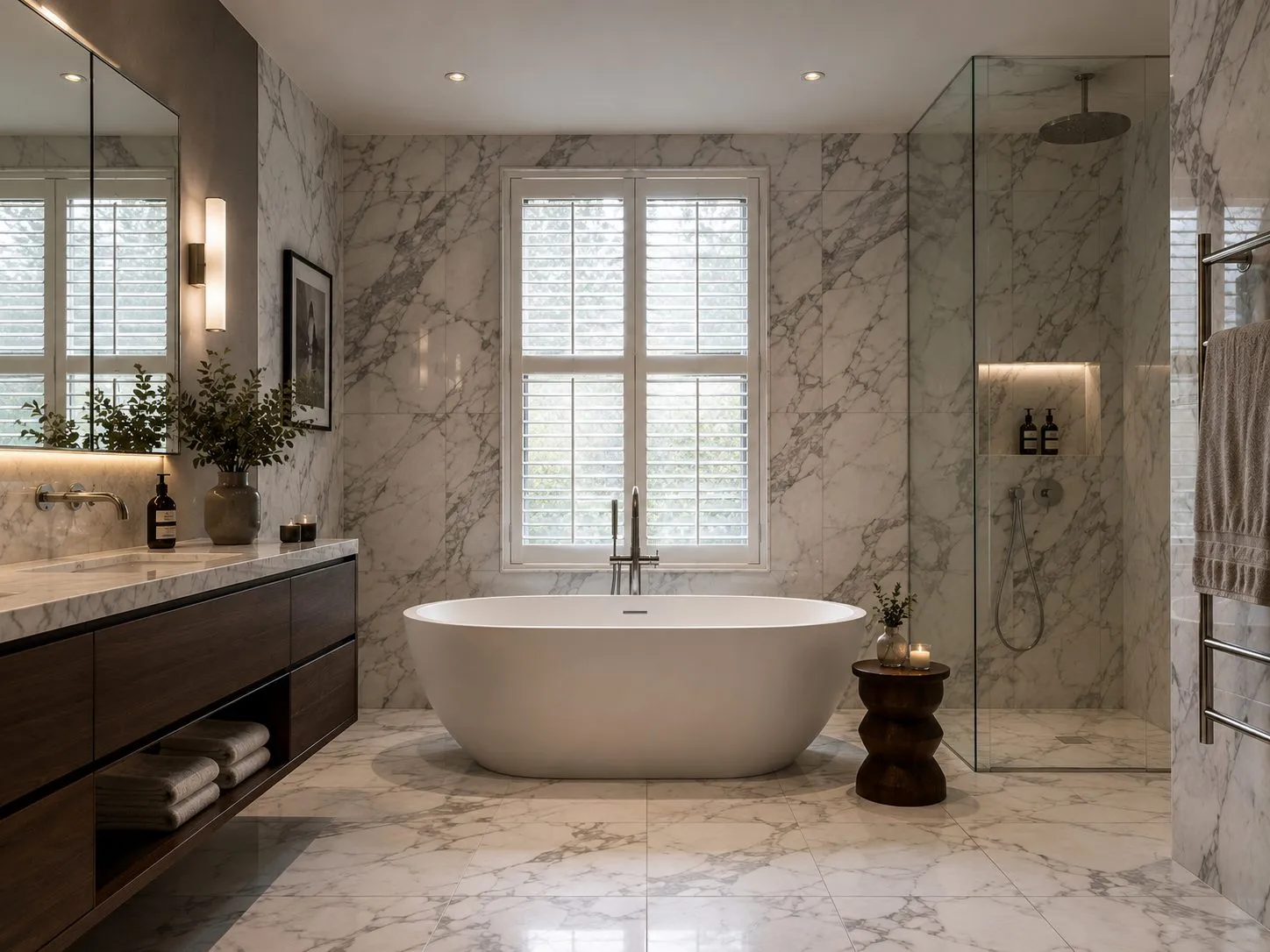
Our residential work spans the full scope of high end building. We deliver architecturally distinctive new build homes, private residence refurbishments and structural reconfigurations, single and multistorey extensions, basement excavations, listed and period property works, and the bespoke joinery and interiors that define a finished home. Each project is delivered as design and build or contractor only, with Crown appointed as your prime residential main contractor, and transparent, itemised pricing from the outset. Commercial occupiers are served by the same teams through our commercial fit out division, and clinical and wellness premises through our healthcare and specialist environments team.
The best of Hemel sits in its older quarters: Boxmoor's Victorian and Edwardian villas beside the moor, the listed Georgian buildings of the Old High Street conservation area, and the generous detached homes of Felden and Shendish. These are properties that reward proper investment, sympathetic extension, structural reconfiguration, complete services renewal and finishes specified well above the local norm. As one of the largest towns within fifteen miles of our office, Hemel is comfortably inside our daily operating radius, with senior management able to attend site routinely.
Areas we serve
We cover Boxmoor, the Old Town, Felden, Shendish, Leverstock Green and Apsley, along with neighbouring Kings Langley, Abbots Langley and Berkhamsted. You can see our full coverage, London within the M25 and a fifteen mile radius of our Watford headquarters, on our areas we cover page.
The 130 per cent Green Belt rule has been disapplied. Most sites still quote it.
If you have read that extensions in the Dacorum Green Belt are capped at 130 per cent of the original dwelling's floor area, that guidance is out of date, and the Council itself says so in writing.
The figure comes from saved Policy 22 of the 2004 Local Plan. But Dacorum's own Policy Advice Note, issued in May 2017, states that the 130 per cent figure is deemed not to be consistent with the National Planning Policy Framework and should not be applied when determining planning applications. The equivalent 150 per cent figure for the Rural Area is described as not entirely consistent either, as planning appeals have shown, though it may be used as general guidance.
What actually governs is the national test of whether additions are disproportionate over and above the size of the original building, with Policy 22's other criteria as local detail: compact design well related to the existing house, sufficient space retained around the building, no visual intrusion on the skyline or open countryside, and no harm to significant trees or hedgerows. The original dwelling means the building as at 1 July 1948, or as first built if later. Getting this right changes what is worth designing, and repeating the old number would understate what may be achievable.
Just over half the borough is Green Belt, not eighty per cent
A second figure worth correcting. Dacorum's adopted Core Strategy states that almost eighty five per cent of the borough is rural, that sixty per cent of that rural area falls within the Metropolitan Green Belt, and that this amounts to just over half the borough as a whole. The widely repeated claim that eighty per cent of Dacorum is Green Belt has no Council source.
Over a third of the borough falls within the Chilterns National Landscape, and Core Strategy Policy CS24 requires support for the principles in the Chilterns Buildings Design Guide and its technical notes on flint, brick and roofing materials. For replacement dwellings, saved Policy 23 requires the original to remain substantially as built or to have been occupied within the preceding three years, and provides that a new dwelling should not be larger than the one it replaces or than the original plus any extension that would have been permitted. Permitted development rights are normally withdrawn by condition on a replacement, so future extensions are controlled.
What actually applies in Hemel, and what does not
Two constraints are commonly misapplied to Hemel Hempstead. The first is the Chiltern Beechwoods Special Area of Conservation. It is a serious constraint: development within 500 metres of the Ashridge Estate and Tring Woodlands is likely to be refused, and a 12.6 kilometre Zone of Influence was reviewed in 2026 and retained. But the Council's own guidance is clear that it normally applies to development resulting in a net gain in new homes, and that other householder, commercial and non residential development should be unaffected. It bites on annexes, subdivisions and any net additional dwelling, where mitigation charges apply per home, rather than on an extension.
The second is Article 4. Dacorum has many directions, but they are concentrated in Berkhamsted and Tring, and none appear in the Council's published table for Hemel Hempstead. The conservation area designated for the town is simply Hemel Hempstead, dating from 1968 and amended in 2014, and Piccotts End is a separate conservation area rather than part of it. Within conservation areas the Council requires written authority for demolishing buildings over 115 cubic metres, and for roof additions and alterations including dormers.
Two local specifics are worth knowing. Hemel is a post war New Town masterplanned by Geoffrey Jellicoe from 1947 around a city in a park idea, and the Water Gardens are a Grade II Registered Park and Garden partly designated for how that civic design integrates with his town plan. And the Core Strategy records that past evidence of chalk mining, while very localised, will affect construction where it occurs, which is a foundation risk worth investigating rather than assuming.
Speak to us about your Hemel Hempstead project
If you are planning a build, refurbishment or extension in Hemel Hempstead, call us on 020 3675 3999 or book a free consultation here. Our head office is Unit 324-B, The Wenta Business Centre, Colne Way, Watford, WD24 7ND.
Frequently asked questions
Where is Crown Building based?
Crown Building's head office is at Unit 324-B, The Wenta Business Centre, Colne Way, Watford, WD24 7ND. We work throughout London within the M25 and across Hertfordshire and the Home Counties.
Which areas around Hemel Hempstead do you cover?
We cover Boxmoor, the Old Town, Felden, Shendish, Leverstock Green and Apsley, plus Kings Langley, Abbots Langley and Berkhamsted.
Do you work on conservation-area properties in Hemel?
Yes. The Old High Street and Boxmoor conservation areas are familiar territory, we manage consents, sympathetic detailing and heritage trades as standard.
Planning a project in Hemel Hempstead?
Crown Building offers a free initial consultation: no cost, no commitment. Speak to our senior team about your project today.
Book a Free Consultation